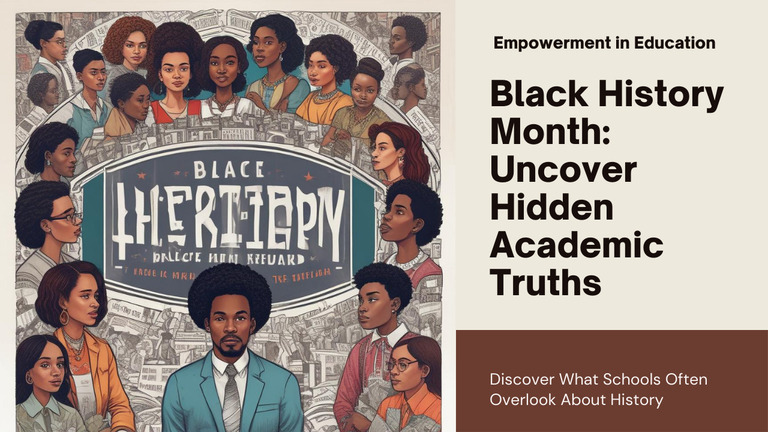
🏛 The Erasure of Black Scholars in Higher Education
Many universities have a long history of excluding Black intellectuals from their narratives. Yet, pioneers like Dr. Carter G. Woodson, the “Father of Black History,” and Anna Julia Cooper, one of the first Black women to earn a Ph.D., shaped academic thought in profound ways.
📌 Did you know? The first Black student at Harvard, Richard Greener (1870), went on to become a distinguished professor and diplomat—but his contributions are rarely discussed.
🔬 Black Innovators in Science & Technology
STEM fields are filled with game-changing Black innovators whose work has reshaped industries. Yet, their names are often sidelined in standard curricula:
🧪 Dr. Marie Maynard Daly – The first Black woman to earn a Ph.D. in chemistry, her research was crucial in understanding hypertension and heart disease. ❤️
🚀 Katherine Johnson – A NASA mathematician whose calculations helped send astronauts to the moon, as seen in Hidden Figures. 🌕
⚡ Lewis Latimer – Played a key role in developing the lightbulb and improving Edison’s designs.
Why aren’t their stories more widely known? 🤔
📖 African History: The Missing Chapters
Most Black history lessons in academia begin with slavery, ignoring the rich civilizations that existed long before colonialism. Universities rarely teach about:
🏺 The Kingdom of Kush – A powerful empire in Northeast Africa, rivaling Ancient Egypt.
📜 Timbuktu’s Ancient Libraries – Home to thousands of scholarly manuscripts on astronomy, medicine, and mathematics. 📚✨
🛡️ The Great Zimbabwe Ruins – Evidence of an advanced society with impressive architecture dating back centuries.
Understanding these histories challenges the one-dimensional narratives that many students are taught.
🎓 The Modern-Day Struggles of Black Academics
Even today, Black scholars and students face systemic barriers in academia:
🚫 Underrepresentation – Black faculty make up a small percentage of professors at major universities.
📉 Funding Gaps – Black-led research and initiatives often receive less institutional support.
⚖️ Curriculum Bias – Eurocentric perspectives dominate syllabi, leaving out Black intellectual traditions and frameworks.
These issues highlight the ongoing fight for representation and equity in education.